
From Venice to USA. Report 2
Venice- the Netherlands - City of London - Federal Reserve. Forty Families Built the Architecture of the Modern World - Priority 2

“Whoever wishes to foresee the future must consult the past.” — Niccolò Machiavelli
— — —
The Question No Standard History Asks
Standard histories of Venice tell a romantic story. A small republic on a cluster of islands in a saltwater lagoon. A maritime trading power. A few centuries of glory. A long, dignified decline. Carnival masks. Gondolas. Casanova. Napoleon arrives in 1797 and ends the show—the end.
This is a useful story for tourism. It is useless for understanding power.
The serious question, the question that almost no popular history asks because the answer is too uncomfortable to sit with, is this. How did a city of roughly one hundred thousand people, perched on wooden pilings in a malarial lagoon, with no agricultural hinterland and no significant natural resources, manage to dominate the trade of the Mediterranean for five hundred years, build the most sophisticated intelligence apparatus in pre-modern Europe, develop the financial techniques on which all subsequent capitalism would depend, and — most importantly — disappear politically in 1797 while persisting structurally in every banking and intelligence institution that has governed the world since?
The answer is the subject of this report.
Venice did not decline. Venice transferred.
The patrician families of the Republic — the families inscribed in the Libro d’Oro, the families who had spent five centuries refining the operational logic of oligarchical rule — did not vanish when the Republic fell. They moved. They moved their capital, their methods, their philosophical outlook, and in many documented cases their actual family fortunes northward — first to Antwerp, then to Amsterdam, then to London, and eventually to New York. They moved before the visible state collapsed. They had time, because they had recognised the trajectory of the lagoon city after the catastrophe of 1509, and they had three centuries to complete the relocation in a manner so gradual that most subsequent historians would never recognise it as a single coordinated transfer.
The water is still the water. The fish are still the fish. The lagoon is just a different lagoon now.
The Geography That Made the Operating System Possible
To understand why Venice — and not Genoa, not Florence, not Pisa, not any of the dozens of competing Italian merchant cities — became the structural prototype of the modern global operating system, you must begin with geography. Not the romantic geography of a city built on water. The strategic geography made a particular kind of state structurally inevitable.
Venice had no agricultural land. This single fact determined everything that followed.
A city without farmland cannot feed itself. A city that cannot feed itself must trade for its survival. A city whose survival depends on trade must control the routes, the contracts, the currency, the information, and the legal frameworks that govern commerce — because if any oan outside power controls any of these, the city dies. From the moment of its founding in the lagoon refugee settlements of the sixth century, Venice was structurally compelled to become what every other Italian city became only contingently. It had to become a state organised entirely around the protection of commercial interest, because there was no other option.
The lagoon also provided something that no land-based city possessed. Defensibility without an army. The shifting channels of the Venetian lagoon were impassable to anyone who did not know them. Land armies could not cross. Rival fleets could not navigate. For nearly a thousand years, no foreign power successfully attacked Venice itself — until Napoleon arrived with the technology of the modern artillery train and the doctrine of total war that the patricians had themselves quietly enabled in their northern transfer.
The geography produced a state form that did not exist anywhere else in Europe at that scale. Not a kingdom. Not a duchy. Not a city-state on the model of Florence or Milan, where a single family eventually consolidated power. Something different. A republic in name, an oligarchy in substance, a commercial empire in operation, an intelligence state in its internal organisation, and a financial laboratory in its institutional design.
This is what Venice contributed to the world. Not the gondola. The blueprint.
The Forty Families
On 28 February 1297, under Doge Pietro Gradenigo, the Great Council of Venice passed the law that would shape the next eight centuries of European political organisation. The law had a name. It was called the Serrata del Maggior Consiglio — the closing of the Great Council.
Before that date, membership of the Great Council — the body that elected the Doge, passed legislation, and controlled the highest offices of the Republic — had been formally fluid. A wealthy merchant could rise. A successful captain could be co-opted. The boundary between patrician and commoner, while real, was not yet legally fixed.
After 28 February 1297, that boundary became permanent and hereditary.
Membership in the Great Council was restricted to descendants of those who had served on the Council in the four previous years. In 1315, the registry of all eligible families was formalised in the Libro d’Oro — the Golden Book — maintained by state prosecutors who recorded every birth, marriage, and death within the patrician class. By the time the system reached its mature form, approximately 200 families were enrolled. Within those 200, a much smaller core — historians estimate between 20 and 40 dominant lineages — controlled the inner committees, the intelligence apparatus, the major commercial networks, and the highest offices.
This is what the title of this report names. Forty families. The number is approximate. The reality is precise.
What was the structural innovation here? Every previous oligarchy in human history had been functionally hereditary but legally informal. Roman senatorial families. Greek aristocratic clans. Frankish nobility. The Venetian innovation was to make the oligarchy legally permanent and self-administering. The state itself became the registry of the ruling class. The class did not merely hold the state. It was the state. It defined who was eligible to govern, who could vote in the highest councils, who could marry whom, and the consequences of these definitions extended for centuries.
This is the first structural lesson Venice contributed to the operating system. Power is most secure when it is institutionalised in a registry that the ruling class itself maintains. Every aristocracy that came after Venice — every closed financial network, every elite university admissions system, every modern foundation board — operates on a variation of this principle. The Libro d’Oro is the prototype. The mechanism is the same. Only the technology of the registry changes.
The Council of Ten
The Serrata closed the gate. The next innovation locked the room.
In 1310, in response to the Tiepolo conspiracy — a failed coup by patrician families who had been excluded from the inner circle — Venice created what would become the most important political institution of the late medieval world. It was called, with characteristic Venetian understatement, the Consiglio dei Dieci. The Council of Ten.
Its formal mandate was the security of the Republic. Its practical mandate was unlimited. The Ten could investigate any patrician, any office-holder, any foreigner, any institution. It could authorise covert operations, issue secret arrest warrants, conduct private trials, and order executions whose details were never made public. It maintained an intelligence network that, by the early sixteenth century, was running operations across the eastern Mediterranean, central Europe, the Ottoman court, and the Iberian peninsula.
The Council of Ten is recognised by historians of intelligence as the world’s first permanent, professionally organised state intelligence service. The Oxford historian Ioanna Iordanou has documented in detail how the Ten built and operated a centralised cryptographic apparatus, a network of paid informants embedded in foreign courts, a counter-intelligence service that monitored Venetian citizens abroad, and even a department for the development of poisons and lethal substances — five centuries before the British SIS, the American CIA, or any of the modern services that consider themselves the inventors of these methods.
What does this matter to the operating system?
Three things matter.
First, the Council of Ten institutionalised the principle that real governance is secret governance. The visible institutions of the Republic — the Doge, the Senate, the Great Council — operated in public, with documented proceedings, in sessions that could be observed. The Ten operated in shadow. Its records were sealed. Its decisions were unappealable. Its members rotated regularly to prevent personal accumulation of power, ensuring that the institution held the power, not any individual within it. This is the architecture of invisibility described in Report 1, in its earliest fully developed form.
Second, the Council of Ten developed the technique that every subsequent oligarchical system has refined. It managed the balance of power within the patrician class itself. When any single family or faction began to accumulate independent influence — wealth, military command, foreign alliances — the Ten neutralised it. Sometimes through exile. Sometimes, through quiet financial pressure. Sometimes through the methods that left no trace. The most famous example was Doge Marin Falier, who in 1355 attempted to elevate his personal authority above the constitutional limits and was executed on the staircase of the Doge’s Palace, his portrait covered with a black shroud in the Council Hall as a permanent warning.
This is the principle that, six centuries later, the City of London would apply to the management of nation-states.
Third, the Council of Ten understood — earlier than any other European state — that information itself is a strategic resource. Venetian ambassadors abroad were required to file long, encrypted reports analysing the political, economic, and personal conditions of every foreign court they visited. These reports were systematically catalogued, indexed, and used to inform commercial as well as diplomatic decisions. Venice had what would now be called an integrated intelligence-commercial complex three hundred years before any nation-state acquired anything similar.
The fish does not see the water. The Council of Ten did not see itself as innovating. It was simply doing what the protection of the operating system required. But what it built became the template for every subsequent secret-governance institution in Western history.
Power First, in Practice
In Report 1, we established the analytical principle that political power must be protected by three sequential mechanisms: political control, property rights that convert control into multigenerational wealth, and information control that prevents those outside the system from understanding how it operates.
Venice did not theorise this sequence. Venice operationalised it.
Political control was guaranteed by the Serrata and the Libro d’Oro. The 200 families and their descendants held a permanent, legally enforced monopoly on the highest offices of the state. No popular movement could remove them, because there was no constitutional mechanism by which an outsider could enter the system. The Republic remained formally a republic while becoming a closed corporation substantively.
Property rights were guaranteed by an extraordinary commercial and legal innovation. Venice pioneered the modern partnership contract — the colleganza — in which capital and labour were separated, profit was distributed by formula, and the resulting wealth could be transferred across generations through a legally protected inheritance system. The commercial law of Venice was, for its time, the most sophisticated in Europe. Contracts were enforceable. Disputes were adjudicated rapidly. Property could be conveyed, mortgaged, leased, and inherited under predictable rules. This is what made Venice the prototype of all subsequent commercial law systems. Karl Marx, hardly a friend of the system, identified Venice as the place where capitalism, in its operational form, first appeared.
Information control was guaranteed by the Council of Ten and the diplomatic intelligence apparatus described above, and reinforced by something more subtle and more powerful. Venice controlled what could be said. Printing presses operated in the city — Venice was, by 1500, the largest publishing centre in Europe — but the Council of Ten exercised continuous oversight of what was published, what was banned, what was permitted, and what disappeared. The Republic’s reputation for tolerance and intellectual freedom was selectively true. It was true for what served the Republic’s commercial and strategic interests. It was not true for what threatened them. Giordano Bruno discovered this distinction in 1592, when he was arrested in Venice on the order of the Roman Inquisition with the cooperation of the Venetian authorities, and burned at the stake in Rome eight years later. The episode tells the truth about Venetian “tolerance” more accurately than any humanist tract.
The three layers — political, property, informational — were not invented in Venice. But they were integrated in Venice for the first time in a single, durable institutional architecture. This is the first complete instantiation of the operating system. Every later instantiation — the Dutch Republic, the British constitutional monarchy, the American republic — is a reworking, in different costumes, of the same Venetian template.
The Catastrophe That Changed the Plan
In 1498, Vasco da Gama rounded the Cape of Good Hope and reached India by sea. The Portuguese had broken the Venetian monopoly on the spice trade.
In 1508, the major European powers signed the League of Cambrai — Pope Julius II, Holy Roman Emperor Maximilian I, King Louis XII of France, and Ferdinand II of Aragon — explicitly to dismember the Venetian terraferma empire and partition its mainland territories.
On 14 May 1509, at the Battle of Agnadello, the French army destroyed the main Venetian field force. Within two months, Venice had lost almost all of its mainland territory. The Republic was reduced to the lagoon itself — defensible, but stripped of the agricultural and commercial hinterland that had sustained it.
Venice survived the Cambrai war diplomatically. By 1516, through skilled negotiation and the inability of the allied powers to coordinate, the Republic had recovered most of its territorial losses. From the outside, the war looked like a frightening interruption that ended in restoration.
From the inside — and this is the analysis that distinguishes structural history from textbook chronology — the Cambrai catastrophe was the moment the patriciate understood that the lagoon was no longer a viable base for world domination. The Republic could survive. It could persist. It could even regain its former territories. But the strategic position of the early thirteenth century — when Venice was the unrivalled commercial power of the Mediterranean and the Mediterranean was the centre of world trade — was gone, and was not coming back.
The Mediterranean was no longer the centre. The Atlantic was. The discovery of the New World in 1492 had moved the centre of gravity of the world economy westward. Portuguese ships were running Indian spices around Africa. Spanish silver was flooding Europe through Seville. The future of global commerce — and therefore of any operating system that wished to govern that commerce — would not be played out in the Adriatic. It would be played out on the Atlantic seaboard.
Some patricians understood this earlier than others. The faction that grasped it most clearly was known as the giovani — the “young” — clustered around the Servite friar and political theorist Paolo Sarpi (1552–1623). Sarpi was nominally a Catholic priest. In practice, he was the chief intellectual operative of the faction that maintained sustained correspondence with Protestant scholars, English statesmen, and Dutch merchants — the precise networks through which the Venetian operating system would be transferred northward over the following century.
The historian Webster Tarpley, building on earlier work, has argued that what happened next was a deliberate, multi-generational programme of relocation. The argument can be summarised in one line.
The Venetian oligarchy did not wait to be defeated. It moved.
The Transfer
This section requires the highest tier of evidentiary care. The full claim — that a coordinated faction within the Venetian patriciate consciously planned and executed a multi-generational transfer of capital, methods, and personnel to northern Europe — is interpretive history of the kind associated with Webster Tarpley, Joseph Farrell, the LaRouche school of historical research, and on the Russian side with the structural analysis of Andrei Fursov. It is not the consensus reading. The consensus reading treats the rise of Amsterdam and London as essentially independent phenomena, driven by Dutch and English commercial ingenuity, with Venetian decline as background context rather than causal mechanism.
What is documented beyond serious dispute is this.
Venetian commercial techniques — double-entry bookkeeping, the bill of exchange, marine insurance, the joint-stock partnership, the holding company structure — were systematically adopted by Antwerp merchants in the first half of the sixteenth century, then transferred to Amsterdam after the Spanish sack of Antwerp in 1585.
The Bank of Amsterdam, founded in 1609, was modelled directly on Venetian banking institutions. Its founders, the city authorities of Amsterdam, openly acknowledged Venice as the prototype.
The Dutch East India Company (VOC), founded in 1602, was the first joint-stock corporation with permanent capital and tradeable shares — but the underlying legal innovations were refinements of Venetian commercial partnership law that had been in operation for three centuries.
By the late seventeenth century, Amsterdam was the financial capital of the world. By the early eighteenth century, that role had passed to London, with the founding of the Bank of England in 1694 and the development of the London capital markets.
What is interpretively contested but supported by significant circumstantial evidence is whether this transfer represented an organic evolution of European commerce or a deliberate relocation of methods, personnel, and capital by Venetian-aligned networks. The evidence supporting the deliberate-transfer thesis includes:
— Specific Venetian families — the Mocenigo, Foscarini, Querini, and others — appear in the commercial records of Amsterdam and London during the seventeenth century, often with quietly transferred fortunes that the Venetian state had no record of repatriating.
— Paolo Sarpi’s correspondence network connected Venice directly to the English court of James I, to Hugo Grotius in the Netherlands, and to Protestant scholars across northern Europe — and the topics of these correspondences included the precise institutional and legal questions that would, decades later, structure the Bank of England and the Dutch financial system.
— The methods that appeared in Amsterdam and London — the central bank-and-treasury synthesis, the use of public debt as an instrument of state-class fusion, the integration of intelligence and commerce, the management of factional balance through secret committees — are not merely similar to Venetian methods. They are sometimes near-identical replications of them, in contexts where there is no obvious causal pathway other than direct transfer of operational knowledge.
This is where intellectual honesty requires precision. The transfer thesis is plausible, well-supported, and historically coherent. It is not yet proven in the sense that a single primary-source document captures the planning meeting in which the relocation was decided. Such a document, if it ever existed, would not have been written down by people who understood the Council of Ten’s principles of operational secrecy.
But the pattern is the evidence. And the pattern is unmistakable.
When the Republic of Venice formally fell to Napoleon in 1797 — when the last Doge, Ludovico Manin, abdicated and the Great Council voted itself out of existence after a thousand years of operation — the operating system did not fall with it. It had already moved. The lagoon city was an empty shell. The methods, the families, the capital, the philosophical outlook — all of these were now operating in Amsterdam and London, with branch operations in Hamburg, Geneva, Vienna, and the new American republic that the British system had recently helped establish.
Napoleon did not destroy Venice. Napoleon dissolved a corporation that had already transferred its assets.
The Comparative Claim
The thesis of this report can now be stated in its full form.
The Republic of Venice is not a curious survivor of medieval commerce that happened to influence later financial centres. It is the structural origin of the global operating system that has governed the world for the past five hundred years. The forty families — and the two hundred families enrolled with them in the Libro d’Oro — invented the integrated architecture of oligarchic governance, intelligence-as-state-function, hereditary commercial privilege, and information control that every subsequent capitalist power has reproduced, refined, and extended.
What changed was the location. What did not change was the operating system.
This claim has three implications that deserve direct statement.
First, the so-called rise of the West — the emergence of Dutch, English, and eventually American global dominance from the seventeenth century onward — is not a story of national genius or Protestant ethic or scientific revolution producing economic miracles in previously unimportant peripheries. It is the story of an existing operating system, developed over five centuries in a specific Italian city-state, being transferred to more strategically advantageous locations as the geography of global commerce shifted from the Mediterranean to the Atlantic. The cultural and religious differences between Venice and Amsterdam, or between Amsterdam and London, are real but secondary. The continuity of method is the primary phenomenon.
Second, the institutions that govern the contemporary world — central banks, sovereign wealth funds, supranational regulatory bodies, hedge funds and family offices, intelligence agencies, foundation networks — are not modern inventions designed to manage modern problems. They are direct descendants of Venetian institutional forms, refined across five centuries, and now operating at a scale and with a technological capacity that the original architects could not have imagined but would have immediately recognised as their own work.
Third, the people who run these institutions today — the senior figures in central banking, supranational governance, financial diplomacy, and the intelligence services — are operating on a methodological tradition that is older than every nation-state in which they function. Their primary loyalty, when the visible national institutions and the underlying operating system come into conflict, is to the operating system. This is not a conspiracy. It is a structure. It is what the Venetian patriciate built, what the giovani transferred, and what the City of London inherited, refined, and now manages.
The fish, as the epigraph of this series reminds us, is the last to discover water.
This is the lagoon. Now you can see it.
A Note on Method
The hardest historiographical question of this report is the distinction between the documented history of Venetian institutions — about which there is no serious scholarly dispute — and the interpretive thesis that connects those institutions to the modern global operating system through a deliberate transfer to northern Europe.
The first body of evidence is documented. The Serrata of 1297, the Libro d’Oro of 1315, the Council of Ten established in 1310, the War of the League of Cambrai of 1508–1516, the role of Paolo Sarpi in the giovani faction, the founding of the Bank of Amsterdam in 1609 on Venetian models — all of this is in the standard scholarly record, supported by primary-source archives in Venice, Rome, Madrid, and London.
The second body is interpretively contested. The thesis that the rise of Amsterdam and London represents a deliberate, coordinated relocation of the Venetian operating system, rather than an organic European commercial development, is associated with researchers including Webster Tarpley, Joseph Farrell, the historians of the Schiller Institute, and, on the Russian side, with Andrei Fursov, Valentin Katasonov, and the structural-historical school. It is not the consensus reading in mainstream Anglo-American academic history. It is supported by significant circumstantial evidence — the family migrations, the institutional replications, the documented correspondence networks, the precise pattern of methodological transfer — and it is consistent with the way the operating system has demonstrably continued to operate since 1797.
The reader is asked to hold both bodies of evidence with appropriate seriousness. The documented history is the foundation. The interpretive thesis is the structural reading that makes sense of how the operating system has actually behaved across the centuries that followed.
What we will not do in this series is collapse the distinction. The document is documented. The interpretive is interpretive. Both deserve their proper weight, and the reader deserves to know which is which.
The standard, as in Report 1, is not a consensus. Consensus is often the operating system’s most effective protection mechanism. The standard is documentation, logical consistency, and intellectual honesty about the limits of what can be known.
— — —
Something big is really happening. Now you can see the second layer of it.
— — —
Next: Report 3 — The Black Nobility of Rome: Massimo, Pallavicini, and the Thousand-Year Families That Outlasted Every European Revolution
INVESTIGATING HISTORY is a Pattern Intelligence Series published by Ability Academy.
www.ability-academy.net
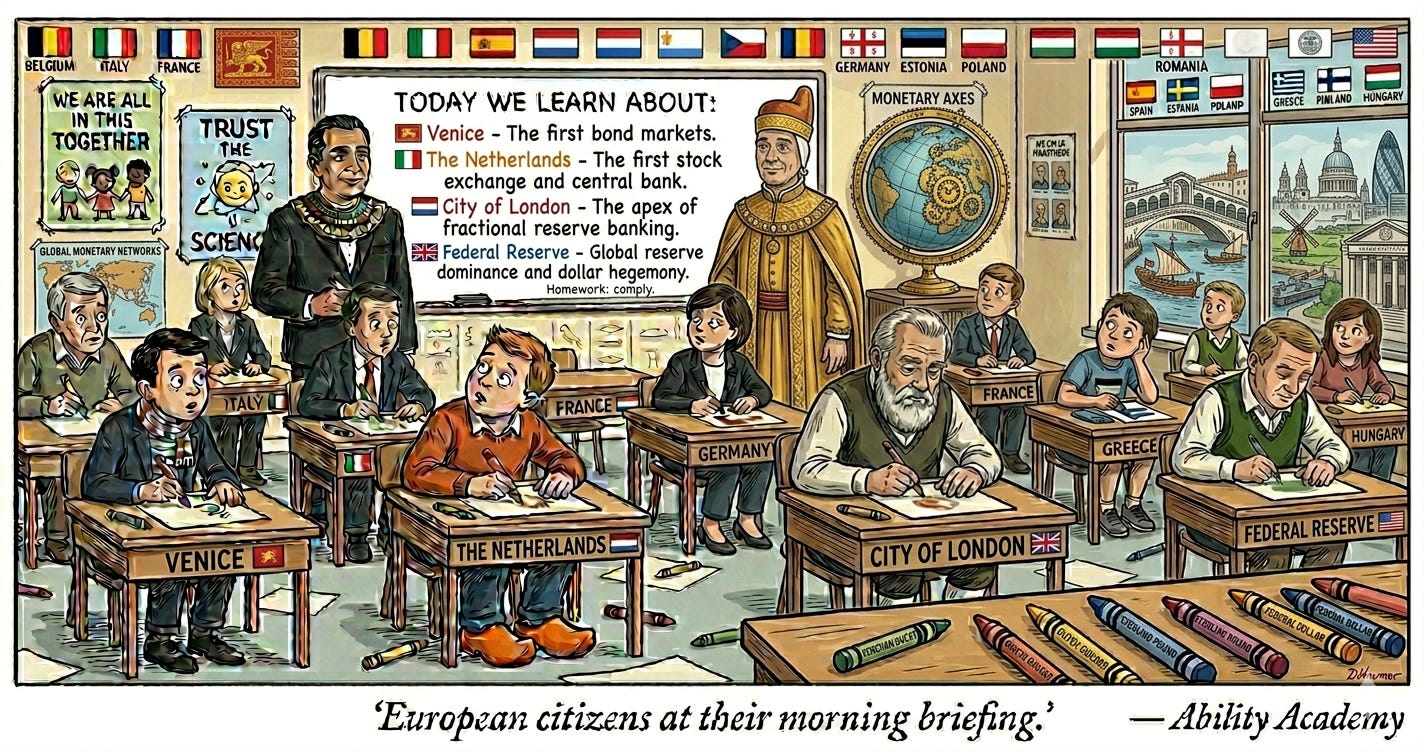
Venice was moved to the Netherlands 5 centuries ago. Then Became the city of London, and now we know it as the Federal Reserve Bank.