
Nation · Family · Property
Global Architecture Is Dismantling the Three Pillars of Civilisation - Biology / genetics / Priority 5

Something big is really happening.
Not as isolated events. Not as accidents. Not as the random chaos of history doing what history does.
What has happened since 1991 — accelerating through 2001, through 2008, through 2020, to right now — is a coherent structural programme. Three targets. Three pillars of human civilisation that, once removed, leave a population politically powerless, socially atomised, and economically dependent.
The three targets are the Nation. The Family. And Private Property.
This is the first report in a series that will document that programme — confirmed fact by confirmed fact, source by source — and connect it to what you can actually do about it.
The Logic That Drives …
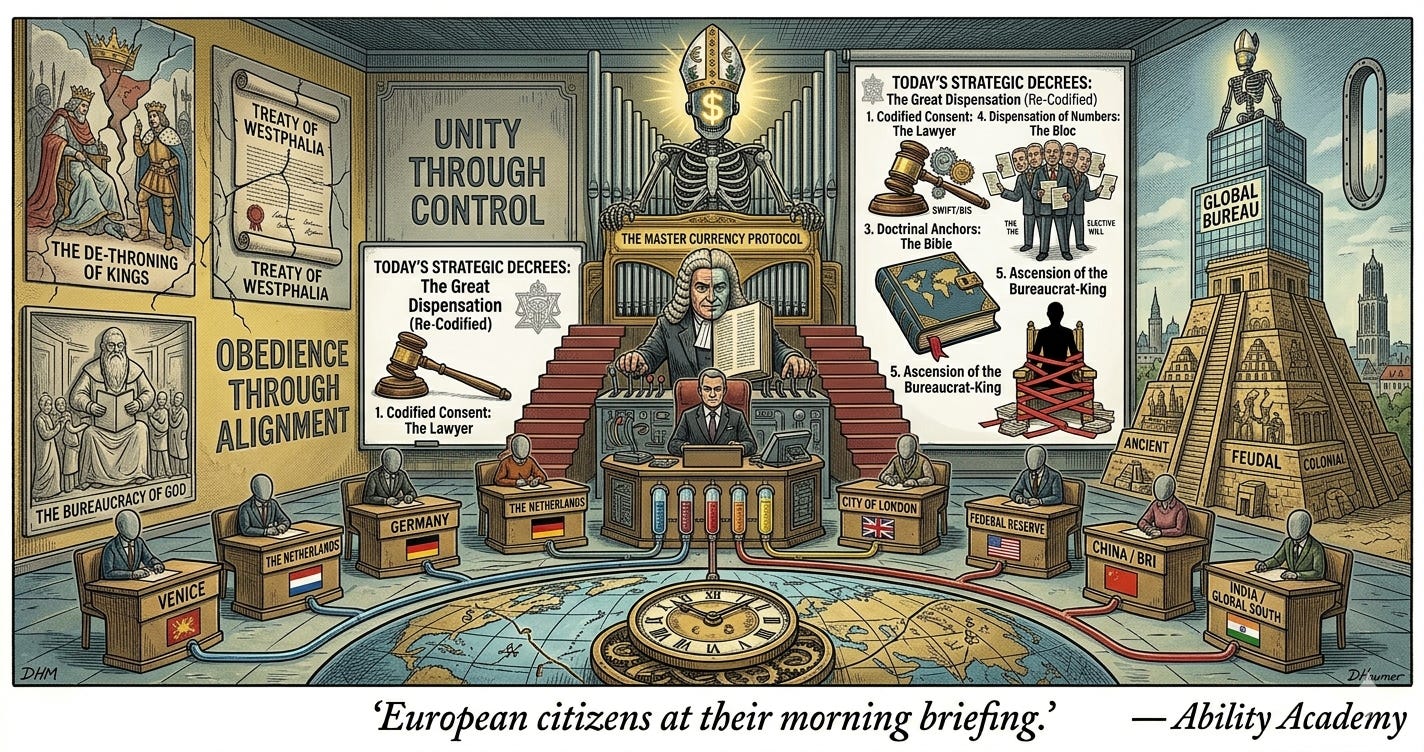
Before tracing the sequence of events, we need to state the underlying structural logic that makes that sequence coherent. Without this, the events look like separate crises. With it, they form a programme.
The logic is this: even the weakest functioning nation state possesses something no corporation and no criminal organisation can match — a monopoly on legitimate coercive force within its territory, combined with accountability structures that, however imperfect, give citizens a mechanism to resist, replace, and constrain power.
This is not a marginal advantage. It is a categorical one. A corporation can buy politicians. It cannot imprison them for non-compliance. A criminal syndicate can intimidate populations. It cannot legislate. A supranational body can issue directives. It cannot enforce them without the coercive apparatus of member states.
The nation-state is the one structure through which organised popular resistance to concentrated private power remains structurally possible.
David Rockefeller stated the inverse of this logic openly in his own memoirs. He wrote: “Some even believe we are part of a secret cabal working against the best interests of the United States... to build a more integrated global political and economic structure — one world, if you will. If that’s the charge, I stand guilty, and I am proud of it.”
This was not a slip. It was a confession of strategic intent, published in 2002, by the man who co-founded the Bilderberg Group, which since 1954 has convened the senior political, financial, and media leadership of the Western world in annual closed sessions to advance precisely this agenda.
The nation-state is not being dissolved because it is inefficient. It is being dissolved because it is an obstacle. Family and property go with it — because a population without political containers for collective action, without social structures for mutual support, and without material assets for independence is a population that can be managed rather than governed.
This is the logic that explains Yugoslavia. It explains Iraq, Libya, and Syria. It explains the European Commission. And it explains why all three moves — against the nation, the family, and property — happen simultaneously rather than sequentially.
Now we can trace the sequence.
Where It Really Started: Yugoslavia, 1991
Most people date the current disorder to September 11, 2001. That is the wrong starting point.
The correct starting point is 1991 — the year the Soviet Union dissolved, the Cold War ended, and the unipolar moment began.
Before 1991, the world operated under a different logic. The bipolar structure of the Cold War imposed a kind of discipline on both sides. The Soviet Union constrained Western adventurism by maintaining a credible counter-force. Western powers constrained Soviet expansion through the same logic in reverse. Nation-states in the developing world could play one superpower against the other, extracting concessions and maintaining meaningful sovereignty precisely because they had options.
When the Soviet Union collapsed, that discipline disappeared. There was now one dominant power — and one dominant agenda.
The first major test case of the new world order was not Iraq. It was Yugoslavia.
Yugoslavia was a multi-ethnic, multi-confessional federation — held together by a political architecture that kept its internal contradictions in managed tension. When that architecture was targeted, and Western-backed separatist movements were actively supported, Yugoslavia fragmented. One country became six. Then seven. The eight — Kosovo declaring independence in 2008, recognised immediately by the United States and most of the EU.
This matters because Yugoslavia established the template. Not the military template — the political template. The template for how a functioning nation state gets converted into a collection of smaller, weaker entities that are individually too small to resist external pressure, individually too dependent on outside powers for security and finance, and individually unable to project any meaningful sovereignty.
The NATO bombing of Yugoslavia in 1999 was the first time in its history that NATO acted outside its treaty mandate. No UN Security Council authorisation. No declaration of war. A military alliance built entirely on the premise of collective defence conducted an offensive war against a sovereign European nation-state.
That was a template, too. And it was used again. And again. And again.
The Seven Countries in Five Years
In 2007, General Wesley Clark — former Supreme Allied Commander of NATO — gave a recorded interview in which he described a conversation he had in the Pentagon shortly after September 11, 2001. A senior military official showed him a memo from the Office of the Secretary of Defence. The memo described plans to take down seven countries in five years: Iraq, Syria, Lebanon, Libya, Somalia, Sudan, and Iran.
Whether or not the memo was exactly as Clark described it, what actually happened in the years that followed aligns with that list with striking precision.
Iraq was invaded in 2003. The state apparatus was dissolved on the orders of the US administrator L. Paul Bremer. The Iraqi army was disbanded overnight, creating several hundred thousand armed, unemployed, and humiliated men with military training and no income. The sectarian civil war that followed was not an accident. It was the predictable structural consequence of deliberately destroying the only institution capable of holding the country together.
Libya received a NATO air campaign in 2011. Muammar Gaddafi was killed. The state collapsed. There is currently no functioning Libyan government. There are two rival administrations, multiple armed militias, and open-air slave markets — documented by the United Nations — operating on the territory of what was, in 2010, the African country with the highest Human Development Index on the continent.
Syria experienced a regime-change campaign from 2011 onward — a proxy war funded and armed by multiple external powers, with an estimated half a million dead. The country is partitioned in practice between four separate zones of control, none of which constitutes a functioning sovereign state.
The pattern across every one of these cases is identical. In every instance, the intervention produced not a functional state but a failed one. In every instance, central government was destroyed and replaced not by democracy but by fragmentation — tribal, sectarian, militia-based, and permanently dependent on external actors for any semblance of order.
If the objective had been democracy, this would be a record of catastrophic failure. But if the objective was the elimination of sovereign nation-states as meaningful units of political organisation, then the outcome in every case is not a failure. It is a success.
Gaddafi’s Warning — And What It Became
Before the NATO intervention in Libya, Muammar Gaddafi issued a warning to Europe that deserves to be read in full, because it has aged with extraordinary precision.
He said: If you destroy Libya, Europe will turn black. He meant it as a deterrent. What happened next suggests that for certain actors in Brussels and beyond, it functioned not as a threat but as a blueprint.
The destruction of Libya removed the primary transit management point for African migration across the central Mediterranean. Under Gaddafi, Libya had maintained bilateral agreements with Italy to manage migration flows. His security apparatus actively controlled the transit routes. When that apparatus was destroyed, the central Mediterranean route opened fully and immediately.
Between 2014 and 2016, over a million people entered Europe via Mediterranean crossings. The political crises that followed — in Germany, Hungary, Italy, Austria, Sweden, France — did not emerge from the migration itself in isolation. They emerged from the collision between mass unmanaged population movement and the existing social architecture of European nation-states that had neither the political will nor the institutional capacity to integrate it.
The structural point that demands to be made clearly is this: the same political forces that destroyed the states that produced the migration also used the resulting migration wave to advance the dissolution of European national identities. The crisis was created. The crisis was then used. These are two separate moves by the same hand.
The Organised Parallel Society
There is a specific dimension of what followed that rarely gets stated with structural precision. It needs to be stated now.
When you import large populations from societies with strong communal organisation — organised along religious, tribal, or clan lines — into atomised Western societies where the individual has been systematically severed from comparable communal structures, you create an asymmetry of organised power that has real, measurable consequences.
The communal group has an internal hierarchy, communication structures, economic networks, dispute resolution mechanisms, and a clear sense of collective interest. The atomised majority population does not. Its families have been weakened. Its trade unions hollowed out. Its churches are empty. Its civic associations defunded. Its local identities are delegitimised as parochial or reactionary.
In Britain, this asymmetry now manifests in documented patterns of differential law enforcement. When policing communities with strong internal organisation, officers calibrate their approach against the risk of communal response — political, legal, reputational, and sometimes physical. When dealing with a disorganised majority individual, no such calculation is required.
This is not a conspiracy. It is rational institutional behaviour responding to a structural reality: organised constituencies produce consequences for those who offend them. Disorganised ones do not. The police, like all institutions, respond to incentive structures.
The question this raises is not about any particular community. The question is: who benefits from a majority population that has been systematically stripped of its communal organisation?
Who benefits from the destruction of the family, the primary unit of communal organisation for any population?
Who benefits from the atomised individual who has no kinship network, no religious community, no trade union, no civic structure — only his individual relationship with the state and the corporation?
The answer to that question is the answer to this entire project.
The Systematic Dismantling of Nations: Four Mechanisms
The destruction of the nation-state as a meaningful political unit proceeds through four distinct but interlocking mechanisms. All four are operating simultaneously right now.
The first is military destruction. Yugoslavia, Iraq, Libya, Syria. The physical obliteration of state infrastructure and the replacement of the central government with permanent fragmentation. The mechanism is not nation-building. It is nation-dissolving.
The second is institutional absorption. The European Union is the primary case study. Twenty-seven nation-states have progressively transferred legislative, judicial, monetary, and increasingly military sovereignty to the European Commission — a body whose members are not elected by European citizens and cannot be removed by European citizens. Mikhail Gorbachev observed that what the EU was building structurally resembled the Soviet Union more than any traditional European political order. He was right. The mechanism differs. The structural logic is identical: sovereignty transferred upward to an unelected body that sets policy for member states that can implement but not override it.
The third mechanism is financial dependency. Nation-states that cannot control their own currency, cannot set their own interest rates, and depend on international bond markets for fiscal survival are not sovereign in any meaningful sense. The IMF structural adjustment programmes of the 1980s and 1990s — which conditioned financial survival on the dismantling of state enterprises, the opening of domestic markets, and the adoption of Washington Consensus economics — are the most systematically documented example of sovereignty removal through financial leverage. The formula was applied to Latin America, to Africa, to Eastern Europe after 1991, and to Southern Europe after 2008. The formula is always the same. The result is always the same.
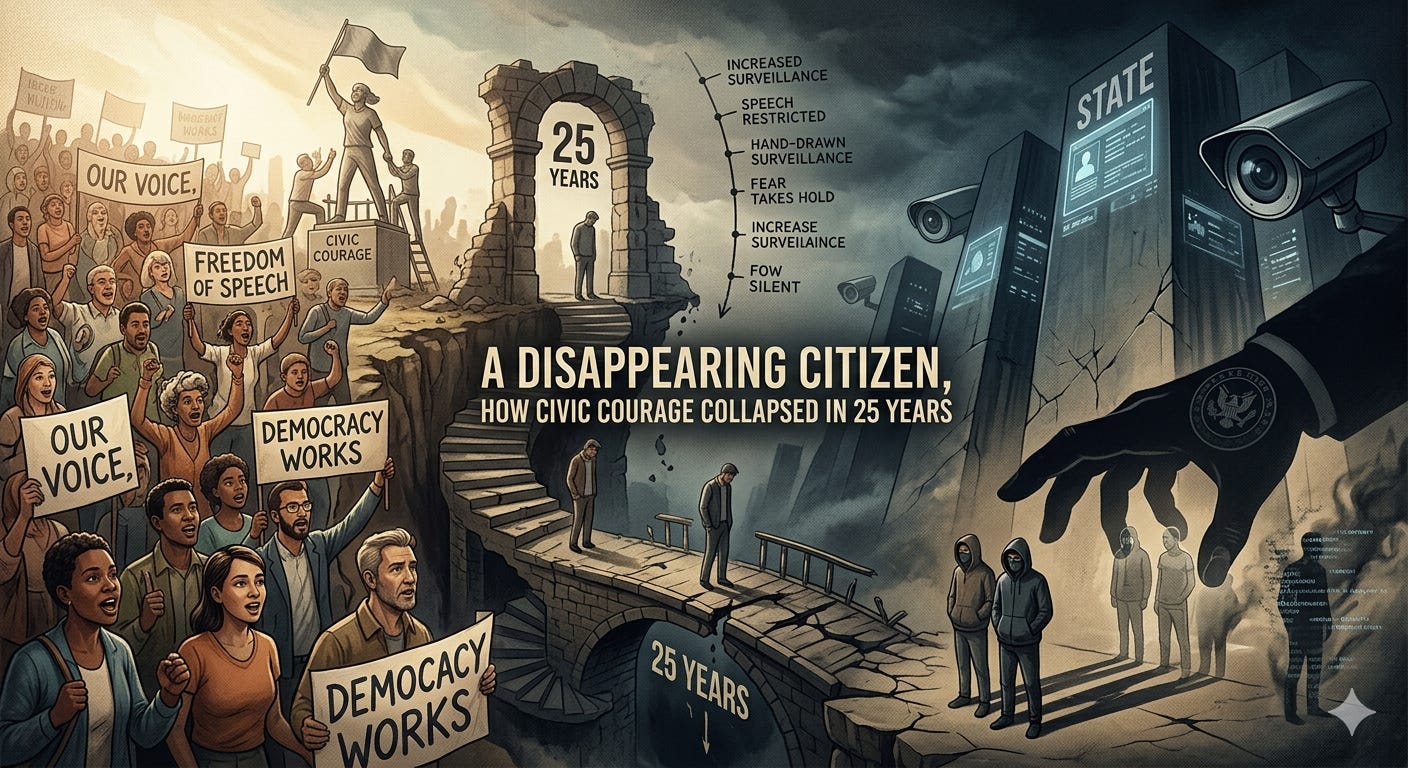
The fourth mechanism is what became known as the terrorism industry. The destruction of functioning states in the Middle East and North Africa produced, as a direct structural consequence, ungoverned spaces in which extremist organisations could recruit, train, and operate. Those organisations then carried out attacks in Western countries. Those attacks were then used to justify the expansion of state surveillance, the erosion of civil liberties, the militarisation of police forces, and the removal of rights from ordinary citizens that would have been politically impossible before the attacks occurred.
This is not to say the attacks were orchestrated from within. It is to say that the structural conditions that produced them were created by the same policy choices that were then used them as justification for their preferred domestic agenda. That is not a coincidence. That is the shock doctrine — the deliberate or opportunistic exploitation of crisis to implement structural changes that would face resistance under normal conditions.
The Family Under Assault
If the nation-state is the political container of sovereignty, the family is the social container. It is the primary unit of cultural transmission, intergenerational wealth transfer, mutual support, and resistance to total state and corporate dependency.
This is precisely why it has been targeted with such consistency and intensity for the past five decades.
The assault on the family is not new, and its intellectual genealogy deserves honest examination. The Frankfurt School — a group of predominantly Marxist theorists who moved from Germany to the United States in the 1930s — concluded that the Western working class had failed to produce the expected socialist revolution primarily because of its cultural and familial attachments. The family, traditional religion, and national identity were identified as the primary psychological obstacles to radical social transformation. Their prescription was systematic: delegitimise all three through cultural criticism, capture the education system, and transform media and entertainment.
Whether or not you accept this specific genealogy, the structural outcome over the following eight decades is measurable. Marriage rates across the Western world have collapsed. Birth rates are below replacement level in every EU member state without exception. Single-parent household rates have tripled in most Western countries since the 1970s. The percentage of adults living entirely alone — the most extreme form of social atomisation — has reached historic highs across Northern and Western Europe.
Under the Biden administration, the most recent and aggressive phase of this assault took a specific and deliberate institutional form: the wholesale institutionalisation of gender ideology across the education system, the legal system, the military, and the corporate HR apparatus.
The agenda was not primarily about the welfare of the small number of individuals who genuinely experience gender dysphoria — a legitimate humanitarian concern that deserves compassionate treatment. The agenda was structural: the systematic dissolution of the binary categories of male and female as the conceptual foundation of family life.
When you can no longer say with legal and social certainty what a man is and what a woman is, you cannot organise a family around those categories. When children are exposed to gender ideology before they are cognitively equipped to evaluate it, you are not expanding their freedom. You are colonising their identity formation with an externally imposed framework designed to sever them from the most basic categories of human experience.
Yuri Bezmenov, the KGB defector who gave a remarkable series of interviews in the United States in the 1980s, described this process in precise detail. He called it demoralisation — the systematic replacement of a society’s value system with a competing framework that, once installed in a generation through education and media, cannot be removed even when its contradictions become apparent. The generation that absorbed it has lost the cognitive tools to recognise what was done to them.
Bezmenov was describing what the Soviet Union was attempting to do from the outside. What is historically unprecedented about the current period is that it is being done from inside — by the institutional apparatus of the states and corporations that are supposed to serve the populations they are instead dismantling.
The Property Transfer: Three Waves of Dispossession
The destruction of private property for the working and middle classes has not happened in a single event. It has proceeded in three distinct waves, each one accelerating the wealth concentration initiated by the previous one. Understanding the sequence is essential to understanding the architecture of what was done.
The first wave was the dot-com bubble of 1995 to 2001. Ordinary people — encouraged to participate in the equity market through pension funds and direct investment — watched a speculative frenzy inflate asset prices to absurd levels and then collapse. The losses were distributed broadly. The gains, extracted by the financial sector that structured, sold, and then shorted the instruments of the bubble, were concentrated narrowly. The transfer was real. The mechanism was designed.
The second wave was the 2008 financial crisis — the largest single transfer of wealth in recorded history. Mortgage-backed securities, collateralised debt obligations, and the shadow banking apparatus produced a crash that destroyed approximately eight trillion dollars in household wealth in the United States alone. The political response was instructive: bank bailouts, quantitative easing, and near-zero interest rates. Not one senior banker went to prison. Not one institution faced genuine consequences. The losses were distributed to ordinary households through falling home values, unemployment, and a decade of wage stagnation. The gains were privatised. The losses were socialised. This is not capitalism. It is extraction wearing capitalism’s clothes.
What emerged from 2008 was a new ownership architecture. With interest rates at zero for over a decade, asset prices were systematically inflated by cheap institutional credit. The entities that could borrow at near-zero rates — large corporations, private equity firms, asset managers — used this access to buy real assets: housing stock, agricultural land, infrastructure, water rights, energy assets. Ordinary households, their net worth destroyed by the crisis and their credit impaired, could not compete.
This is the structural origin of what became the BlackRock housing acquisition programme — the systematic purchase of single-family homes across the United States and elsewhere by institutional investors, converting them from owner-occupied assets into permanent rental income streams. The family home — the primary vehicle of middle-class wealth accumulation across the entire post-war period — is being converted from an asset that families own into an asset that corporations own and families rent indefinitely.
The third wave was COVID. Let us be structurally precise about what happened.
The lockdown policies of 2020 and 2021 were the most effective small business destruction programme in the history of capitalism. In the United States, an estimated 200,000 small businesses closed permanently in 2020 alone. In the United Kingdom, over 400,000. Across the European Union, the figures are similarly catastrophic.
Meanwhile, Amazon’s revenue grew 38 per cent in 2020. Walmart, Costco, and the major supermarket chains recorded record profits. The largest technology corporations — the so-called Magnificent Seven — collectively added over five trillion dollars in market capitalisation between March 2020 and December 2021.
Which businesses were deemed essential and which were not? Which could operate,e and which were forced to close? In every country, in every case, the answer systematically favoured the corporate tier and disadvantaged the small and medium enterprise tier. The large corporations had the balance sheets, the digital infrastructure, the legal capacity, and the political connections to absorb the crisis. Small and medium enterprises did not.
The transfer was not coincidental. It was structural. And it did not stop when the lockdowns ended. The businesses destroyed in 2020 and 2021 did not reopen. Their owners did not recover their capital. Their employees did not return to jobs that no longer existed. The accumulated wealth that small and medium business owners had built across lifetimes — the restaurants, the retail shops, the service businesses, the small manufacturers — was simply gone. Transferred upward. Permanently.
Klaus Schwab called it the Great Reset. He described the outcome as: “You will own nothing, and you will be happy.” He presented this as a vision. The data suggests it was a policy description.
The Pattern, Stated Plainly
When you stand back from the detail and look at the architecture of the last thirty years, the pattern is unmistakable, and the logic is coherent.
Nation-states have been systematically weakened — through military destruction in the global south, through institutional absorption in Europe, through financial dependency everywhere — and replaced with supranational structures that are not accountable to any electorate.
Families have been systematically atomised — through economic pressure that makes single-income household formation impossible, through ideological assault that delegitimises the very categories on which family is built, and through the removal of the cultural framework within which family makes sense — producing populations of isolated individuals with no organic community structure and total dependency on state and corporate provision.
Private property for the working and middle class has been systematically transferred upward — through engineered financial crises, through the asset inflation produced by central bank policy, through the deliberate destruction of small and medium businesses during crisis events — concentrating ownership in a diminishing number of institutional hands.
The three moves are not separate. They are the same move, executed at three levels simultaneously.
Remove the nation, and there is no political container for resistance.
Remove the family, and there is no social container for resistance.
Remove property, and there is no material foundation for resistance.
What remains is the individual — alone, dependent, and manageable.
This is not a conspiracy theory. It is a structural observation, supported by documented facts, from multiple independent analytical traditions, confirmed by the architects themselves. David Rockefeller confirmed it in his memoirs. Klaus Schwab confirmed it in his public statements. The IMF confirmed it in its structural adjustment programme documentation. The BIS confirms it in its annual reports, calling for central bank digital currencies and unified programmable ledgers.
The question is not whether this pattern exists. The question is: what do you do about it?
Why This Moment Matters
We are not at the beginning of this process. We are near its completion — or near the moment when completion becomes impossible because enough people have understood what is happening.
The infrastructure for total control — programmable money, biometric digital identity, centralised data systems, supranational governance architecture — is being built right now. The EU Digital Identity Wallet deadline is December 2026. The BIS Project Agorá unified ledger is in the testing phase. Central bank digital currencies are in active pilot programmes in 49 countries.
The window in which the architecture can be understood, named, and resisted before it becomes operationally irreversible is not infinite.
This is not a reason for despair. It is a reason for clarity.
The first act of effective resistance is accurate understanding. You cannot defend what you cannot name. You cannot name what you cannot see. This series exists to make the pattern visible — precisely, structurally, without ideology, with sources.
Nation. Family. Property.
Three pillars. One programme. One clear choice about which side of that programme you are on.
What Comes Next
This report is the foundation. What follows in this series is the evidence — mechanism by mechanism, actor by actor, verified fact by verified fact.
Report 2 will examine the supranational architecture in detail: the EU as a sovereignty transfer machine, the IMF as a financial leverage instrument, NATO as an offensive tool, and the role of NGO networks in manufacturing the cultural consensus that makes it all politically possible.
Report 3 will document the assault on the family — the intellectual genealogy, the policy implementation across education and law, and the measurable social consequences that most commentators avoid because they challenge the consensus.
Report 4 will map the property transfer in full — BlackRock, Vanguard, State Street, the housing acquisition programme, the ESG mechanism as SME compliance burden, and the CBDC architecture that completes the picture by making property itself programmable and revocable.
Report 5 will examine the counter-forces — what Russia and China are actually doing structurally, what the BRICS architecture represents, and why the multipolar world is neither a solution nor simply a mirror image of the problem it opposes.
Report 6 will connect the structural analysis to the personal level. Because understanding what is happening is only the beginning. The question that matters is what you can actually do about it — for yourself, your family, and your community.
That is what Ability Academy exists to answer.
This report is free. Share it with everyone who needs to understand what is happening.
The analysis connects to practical action at ability-academy.net
#NationFamilyProperty #PatternIntelligence #Geopolitics